

EDLD 5389 Module 3:
Connecting & Communicating
My Ideas
The Big Picture of My PL Plan
Overarching Course Goal: Learners will implement supports in instructional plans to improve the academic performance of emergent bilingual (EB) students by increasing their knowledge of EB students, creating language objectives, incorporating differentiation activities, and developing an inclusive classroom environment.


Call to Action
Why it is needed?
One of the biggest differences between this PL plan and the current RRHS practice is the long-term nature of the plan to include an implementation support phase. My experience of RRHS PL since 2020 has been primarily one-time workshops without follow-up. Studies have shown that without follow-up, few ideas presented in PL are implemented by teachers (TNTP, 2015). As a member of the RRHS PDC, I will advocate for long-term PL using the Call to Action Video created for Module 1 of 5389 (Shaffer, 2023-a). The structure of this PL is divided into two phases: initial learning and implementation support. This duration of my PL plan is at minimum one semester with the option to extend based on the needs of teachers at our campus.
This video is intended for the campus leadership team and professional development committee at Round Rock High School (RRHS). The message in this video is about changes that should be made to make professional development at RRHS more effective. While our campus has made some positive changes in recent years, such as involving teacher presenters and enabling teachers to choose workshops during breakouts, there are still elements of ineffective professional learning that exist. This is evident by the persisting negative attitude of campus staff towards professional learning. Some quotes included in the presentations are based on the sentiments shared by campus staff. These feelings are not unique to our campus as evident in The Mirage report published by TNTP (2015). In order to improve student outcomes, especially for our special populations, we must make professional learning more effective. Effective professional learning enables more effective classrooms.
What needs to change?
To structure the proposal for changing professional learning, I identified three main areas for improvement, and recommendations for each of them, at our campus. These included making development activities relevant, long-term, and engaging for teachers. These three ideas are rooted in the 5 Principles of Effective Professional Development determined by Gulamhussein (2013). I restructured these principles to support the three solutions for improving professional learning. Gulamhussein’s first two principles connect to the need to change stand-alone workshops into long-term initiatives. The long-term nature recommended in my recommendations includes supporting teachers through the implementation phase of initiatives. The third and fourth principles relate to engaging teachers when presenting them with new ideas. Lastly, the fifth principle is about making professional learning relevant by being specific to the discipline of teachers (Gulamhussein, 2013).
How does my plan implement the five principles of effective PL?
1. Duration
One of the biggest differences between this PL plan and the current RRHS practice is the long-term nature of the plan to include an implementation support phase. Initial learning will occur during the 5 of in-service days at the beginning of the school year. The duration of my PL plan is at minimum one semester with the option to extend based on the needs of teachers at our campus. Currently, the implementation support structure is planned for only the first semester with the option to extend into the second semester based on campus needs
2. Ongoing Support
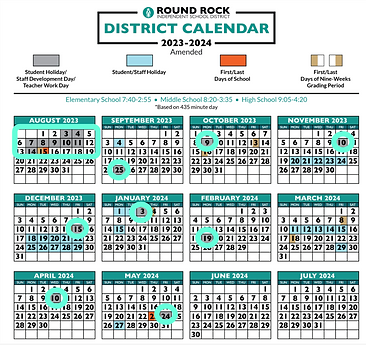
The structure of this PL is divided into two phases: initial learning and implementation support. The second phase will be led by the department chairs and supervising assistant principals. Time is one of the most difficult resources to allocate to professional learning (TNTP, 2015). To maximize the use of existing resources and ensure discipline relevance, follow-up support meetings will occur at the monthly department meetings on PL days. Round Rock ISD has planned for one PL day each month of the fall semester for 2023-24 (Round Rock ISD, 2023). This calendar ensures there are four follow-up meetings during the fall semester.
At the monthly department meeting, 30 minutes minimum will be allotted to implementation support for EB strategies. These meetings usually address results from district common assessments (DCAs) to track student progress. The data from DCAs can help teachers track the performance of EB students to determine if strategies are effective. Additionally, department leaders will be prescribed 5 questions to guide their discussion to identify the challenges, needs, and successes of teachers in their department in relation to supporting EB students. These questions include the invitation to collaborate in the creation of solutions to the challenges faced within the department. A call for volunteers to be observed during learning walks will also be issued during the meeting. The department leaders will submit a summary of their meeting minutes to the administration. The EB department chair, assistant principal, and I will review the meeting minutes to identify possible resources and additional professional learning that can support staff in the implementation of ideas.
Additional time can be allotted towards implementation support during the weekly professional learning community (PLC) meeting held by instructional teams. During this meeting, teachers on shared instructional teams can share the challenges they face and strategies that are successful with peers who teach the same content. The highlights of these conversations can be forwarded to the administration. Currently, it is standard practice for PLCs to submit weekly meeting minutes to their department chairs.
3. Active/Engaging
The activities during the initial learning phase are designed for teachers to create materials that will be used in their classroom during the first unit of the year. Rather than simply passively watching a presenter model the strategies, teachers will actively interact with the learned strategies. Here are some examples from the course:
-
In Module 1, learners will use the proficiency level descriptions to identify the levels of EBs described in scenarios.
-
In Module 2, learners will identify activities in their classroom that align with the ELPS.
-
In Module 3, learners will identify key vocabulary terms in their first unit and create models of differentiated vocabulary activities.
-
In Module 4, learners will create language objectives and a differentiated lesson plan for their first unit.
4. Modeling
Modeling strategies allow teachers to visualize how the learned strategies can be successfully implemented into instruction (Goodwin, 2015). To help teachers to be successful during the creation of these materials, examples are provided. Examples of language objectives are given for all four core discipline areas. Models of the vocabulary strategies taught in Module 3 are given using the term “cognates” from the course to help learners see how they benefit students when working with unfamiliar terms. In addition to the strategies and resources created by teachers, more strategies will be modeled for them. For example, the introduction activity of FlipGrid models a way for teachers to get students to speak in the classroom. Speaking is one of the four elements of language identified in the ELPS (Texas Administrative Code §74.4, 2007).
5. Relevant to Teachers
Materials within the PL are designed to be relevant to all secondary general education teachers at Round Rock HS. Examples and resources of learning objectives and cognates are provided for each core subject area. During the learning activities, teachers are told to choose a lesson from their first unit so they can create the materials that will be used within the next month. By the end of the initial learning period, teachers will have identified ELPS-aligned activities, language objectives, tiered vocabulary with models, culture-building activities, and a fully developed lesson plan to implement during the instruction of their first unit. Teachers will feel more inclined to participate in the PL because it is directly tied to the planning of their instruction (Gulamhussein, 2013).
During the implementation support phase, teachers will be supported within their departments and professional learning teams. During department and PLC meetings, teachers will have the opportunity to share challenges and successes. The prescribed questions for these discussions encourage teachers to work together to develop solutions for challenges their colleagues are facing. By having these discussions with peers in the same discipline teachers will be able to collaborate with those who better understand the content area needs.
Audience & Needs
Why focus on Emergent Bilingual support?
During the spring semester of the 2022-23 academic year, I conducted a preliminary needs assessment regarding the teaching & learning of at-risk students at Round Rock High School (RRHS). The findings of this assessment determined that our Emergent Bilingual (EB) students were significantly behind in both academic performance and attendance (Shaffer, 2023-b). The data analysis meeting was followed up by a root cause analysis in which multiple teachers were invited to collaborate in identifying the reasons for this performance gap. Among the reasons identified within our control was the lack of adequate training for teachers working with EB students (Shaffer, 2023-b). This preliminary finding has led me to develop professional learning (PL) on the topic of implementing support for EB students to improve their academic performance.
Why an online platform?
There are no required all-staff meeting times to accommodate the schedules of over 290 staff members, according to the RRHS 2021-22 TAPR (Texas Education Agency, 2022). Departments and PLCs will meet to collaborate during their traditional monthly and weekly meetings. By using discussion boards, teachers will also be able to communicate with the entire school community about the experience in their own classroom. Many teachers feel isolated in their practice and are unsure of what occurs in classrooms other than their own (Goodwin, 2015). These discussions will allow teachers to view ideas and plans beyond their own discipline area to identify interdisciplinary opportunities.
Teacher Experience
Ubiquitous Access to Materials
Teachers will be able to access all instructional learning materials at any time using the Google Classroom LMS. All resources developed for the PL are adaptable for all disciplines at the secondary level. To help teachers visualize the relation to their content area, examples for language objectives are provided for each of the core disciplines. All articles and videos chosen for this course are relatively brief to ensure the majority of time set aside for PL is spent collaborating about implementing these ideas into the first unit of instruction as recommended by McCammon (2015).
Initial Learning Phase
The plan begins with the initial learning phase in which teachers will learn about the EB population, programs, and strategies to support them. This phase will occur during the first 5 pre-service days in August of 2023. The initial learning will take place with the RRHS staff grouped by departments/disciplines. The sessions will be led by the EB Support Team, which includes the EB department chair, the assistant principal over EB, and myself.
Learners are encouraged to be self-directed through the self-paced nature of the course materials. Each module contains an introduction video that guides the learner through the activities. Additionally, by having access to brief instructional materials learners in the course are encouraged to become self-directed by viewing the materials at a time that works best for them. All learners will develop unique products that serve their classroom's needs.
(Round Rock ISD, 2023; Shaffer, 2023-a)
Implementation Support Phase
After the initial learning phase during the August pre-service days, students will move into the implementation support phase. This phase will be led by the department chairs and supervising assistant principals. Time is one of the most difficult resources to allocate to professional learning (TNTP, 2015). To maximize the use of existing resources and ensure discipline relevance, follow-up support meetings will occur at the monthly department meetings on PL days. Round Rock ISD has planned for one PL day each month of the fall semester for 2023-24 (Round Rock ISD, 2023). This calendar ensures there are four follow-up meetings during the fall semester.
Resources Required
This PL plan does not require the campus to make any significant investments into a curriculum or physical items. All the learning materials and resources are available at no cost online. These materials will be made available to staff using the Google Classroom LMS on the preexisting campus GSuite. Teachers can access the materials using their district-provided laptops. The greatest cost to the district will be the dedicated staff time to experience the initial learning and implementation support meetings. The cost of teachers’ time was identified as one of the greatest costs in professional learning (Gulamhussein, 2013). To maximize existing resources, the proposed PL plan utilizes the predetermined staff development days to prevent the need for extra-duty pay for teachers.
Collaboration
Opportunities for collaboration are implemented throughout both phases of the PL plan.
During the initial learning phase, many activities utilize discussion forums. In these discussions, learners will share their thoughts on learning materials and the initial elements of the products they will create. Teachers will share their thoughts and experiences with those in their departments and PLCs as they create resources to be used within the first unit. By using discussion boards, teachers will also be able to communicate with the entire school community about the experience in their own classroom. Many teachers feel isolated in their practice and are unsure of what occurs in classrooms other than their own (Goodwin, 2015). These discussions will allow teachers to view ideas and plans beyond their own discipline area to identify interdisciplinary opportunities. For example, in the Module 3 discussion, teachers will be encouraged to identify terms that appear outside of their own discipline to reinforce students’ understanding across multiple content areas. Additionally, teachers will be able to receive feedback on their planning process and refine their products accordingly.
Collaboration is the primary element during the implementation support phase. During department and PLC meetings, teachers will have the opportunity to share challenges and successes. The prescribed questions for these discussions encourage teachers to work together to develop solutions for challenges their colleagues are facing. By having these discussions with peers in the same discipline teachers will be able to collaborate with those who better understand the content area needs. However, if the team is unable to identify possible solutions, the EB Support Team will be made aware through the meeting minutes and will subsequently provide additional resources that will help teachers with their specific challenges. Teachers will also be able to share their successes and challenges to a school-wide discussion board to allow for interdisciplinary support and feedback. Lastly, a question included in the discussions will allow teachers to share strategies and resources they have found independently. These resources will be collected by the EB Support Team to develop a shared RRHS Campus Guide to EB Differentiation that teachers can reference at any time. This will enable teachers who join RRHS after the initiative to access vetted resources by discipline.
Evaluation
How will we know if the professional learning plan is effective?
The plan includes multiple approaches to measure the impact of the professional learning plan including the performance of students and the perspectives of both teachers and administrators. The first approach will ask teachers directly to evaluate the learning activities. Responses will be collected using a final reflection on a Google Form. Teachers will be asked their opinion about the learning materials and the value of the products created during learning activities. Later in the implementation support stage, teachers will have the opportunity during instructional team meetings to share their successes and challenges while implementing their learning into the classroom. Highlights of the conversations will be forwarded to the EB Support Team who will develop and provide additional resources to meet the needs of teachers. The impact of the professional learning plan on teachers' instructional practices will also be measured using the TTESS scores related to differentiation. Campus administrators will collect data during walkthroughs, observations, and planning meetings. Lastly, the performance of EB students will be assessed using report card grades, district common assessment scores, and STAAR scores.
References
Desravines, J., Aquino, J., & Fenton, B. (2016). Breakthrough principals: A step-by-step guide to building stronger schools. John Wiley & Sons.
Goodwin, B. (2015). Research says: Does teacher collaboration promote teacher growth? Educational Leadership, 73(4), 82–83. Retrieved from
http://www.ascd.org/publications/educational-
leadership/dec15/vol73/num04/Does-Teacher-Collaboration-Promote-Teacher-Growth%C2%A2.aspx
Gulamhussein, A. (2013). Teaching the teachers effective professional development in an era of high-stakes accountability. Center for Public
Education. Retrieved from http://www.centerforpubliceducation.org/system/files/2013-176_ProfessionalDevelopment.pdf
McCammon, L. (2015). Modeling-based (flipped) professional development at Rutgers University. [Video]. YouTube. Retrieved from
Round Rock ISD. (2023, February 18). District Calendar 2023-24. Round Rock; Round Rock ISD.
Shaffer, S. (2023-a) Call to action. [Video]. Lamar University. Retrieved from https://lamar.yuja.com/v/call-to-action
Shaffer, S. (2023-b) Professional Report. [Unpublished assignment for EDLD 5398]. Lamar University.
Texas Administrative Code (2007) Chapter 74.4 English Language Proficiency Standards. Retrieved from
https://texreg.sos.state.tx.us/public/readtac$ext.TacPage?
Texas Education Agency. (2021). Round Rock High School: Texas Academic Performance Report (2020-21). Retrieved from
https://rptsvr1.tea.texas.gov/perfreport/tapr/2020/index.html
TNTP. (2015). The Mirage: Confronting the Hard Truth About Our Quest for Teacher Development. Retrieved from